
Sprache | Language | בחירת שפה
Between 1863 and 1914, the Jewish community experienced a quiet period. This changed after World War I. Many Germans blamed Jews for the country’s defeat and the ensuing political and economic turmoil. Very early on, antisemitic leaflets, posters, newspaper articles, and public speeches fuelled the perception of Jews as the supposed scapegoats. This laid the groundwork for the later acts of violence against the Jewish population.
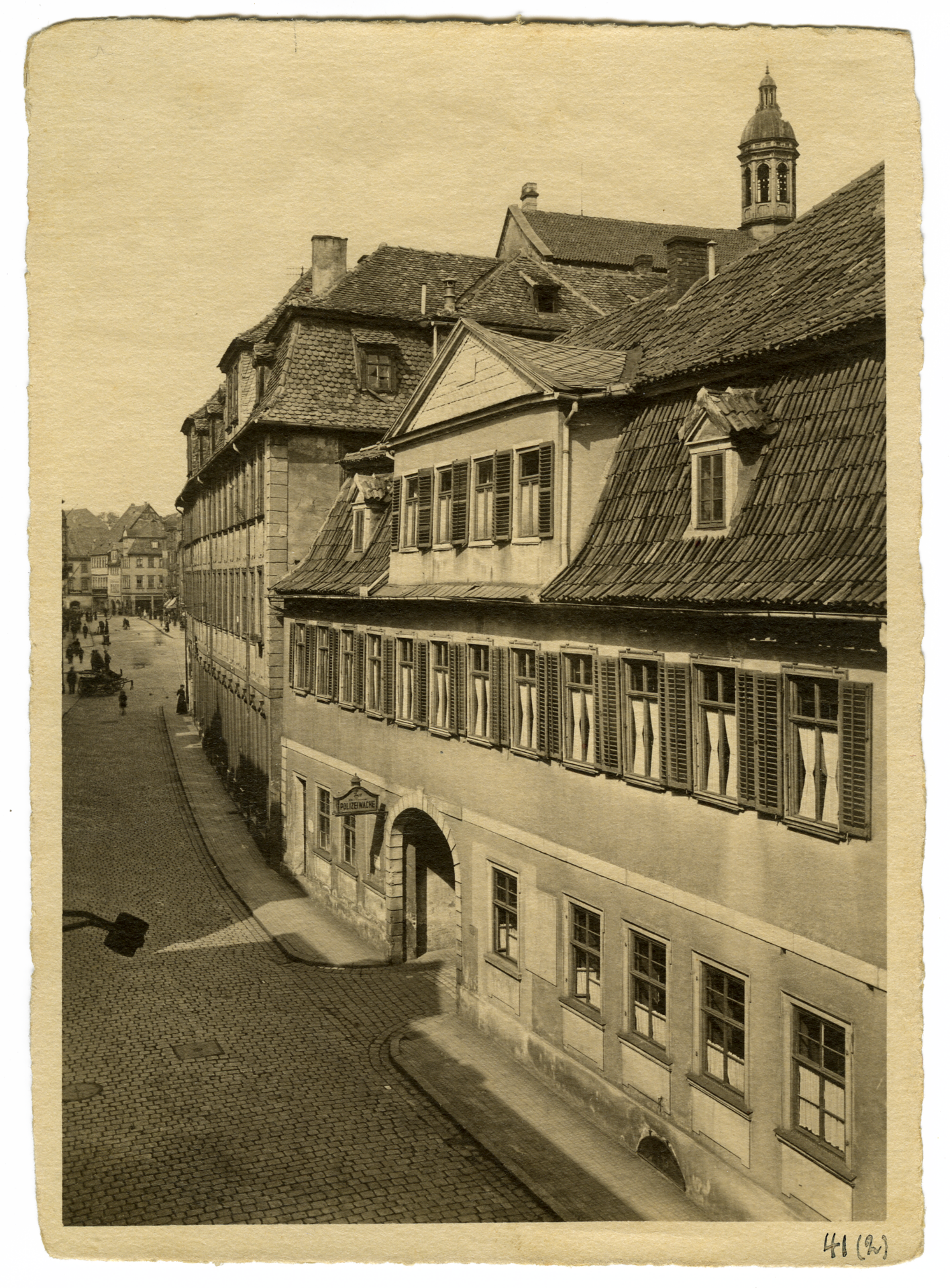
In the first stage, which began in 1929 when the Coburg Nazi Party came to power, acts of vandalism, attacks on Jewish property, and physical assaults on Jewish individuals increased dramatically. A new level of antisemitic violence was reached after Hitler’s rise to power. In March and April of 1933, SA members, who acted as “emergency policemen” to support the work of the municipal police, arrested Jewish citizens as well as political opponents. These detainees were brought to the infamous “Prügelstube” or “beating parlour”, located inside the former city police building at Rosengasse 1. Over time, 40 Jews were imprisoned and tortured there. Criminal proceedings initiated against the “emergency policemen” were quickly dropped by the judiciary.
After 1933, this wave of violence temporarily subsided. It surged again, during the Kristallnacht pogrom in November 1938, when one person was killed. Other Jews were paraded through the streets and pilloried on the market square. The final stage of antisemitic violence came in 1941 with the deportation of Coburg’s Jews to ghettos and concentration camps. Of the 36 deportees, only two women returned.
The original police building was demolished in 1937 and replaced by the current structure. In 1951, the political officials and nine “emergency policemen” responsible for the torture in the “beating parlour” were brought to trial. Of the 14 defendants, five received prison sentences.
The horror in words
“...also heard the terrible screams [...] and the cracking of whips.”
“...was seized with horror every time he saw the pools of blood, the splatters of blood and excrement on the floor and walls.”
“...was abused at least once almost every day.”
“...he was completely battered, especially his face. His suit was completely torn to shreds.”
“...roared during his flogging as he had never heard an animal roar before.”
“...was beaten so badly that he had to walk with two sticks.”
“In his despair, he tried [...] to slit his wrists.”
(Quotes from: Fromm, Coburger Juden², pp. 62-67)
Next station
Jews returned to Coburg in the 19th century. Initially equal, they were later persecuted and deported — by 1942, the Jewish community was destroyed.
About the Path of remembrance
The memorial path “Jewish Life in Coburg” commemorates the city’s Jewish community in 14 stations. These stations trace the history from the community’s integration into Coburg’s civic life in the mid-19th century to its annihilation following the early seizure of power by the National Socialists.
Jewish citizens were an integral part of Coburg’s community for decades. Under National Socialism, the Jewish community and its members were eradicated. They had to flee or were murdered. It is our responsibility to keep the memory of their contributions and suffering alive in the town of Coburg.
In 2023 the Coburg town council decided to commemorate Jewish life in Coburg with a memorial path through the town. The memorial path was officially inaugurated on 31 July 2025.